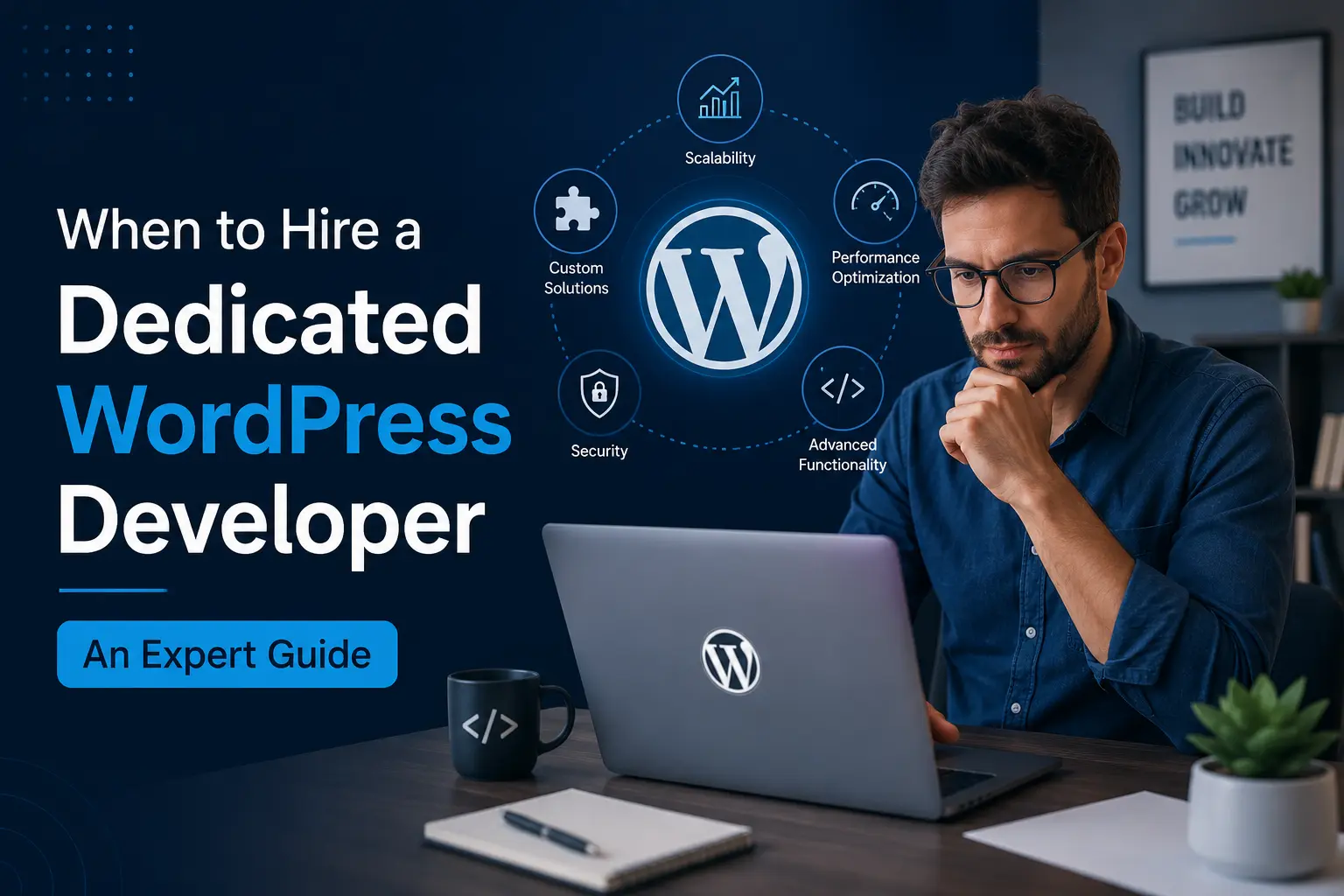
When to Hire a Dedicated WordPress Developer – Expert Guide
Most small businesses start their web presence the exact same way: they buy a $60 pre-built theme, install a visual page builder, and load up on plugins to get the features they need.
For a while, this gets the job done. However, as your site traffic continues to grow and your business scales, those decisions start to catch up with your business. Your site takes forever to load; plugins conflicts start to break things; and your search rankings begin to take a nosedive, because Google is penalizing you for the poor user experience.
At this stage, adding another optimization plugin won’t save you. Here is exactly when to hire a dedicated WordPress developer to rebuild your infrastructure.
The Tipping Point: Why DIY WordPress Sites Hit a Wall
One of the main reasons using WordPress appeals to first-time site owners and small businesses is because of the autonomy and beginner-friendliness it promises. Hosting companies go out of their way to promote features like one click WordPress installation in order to entice first-timers and small businesses. They understand that asking you to setup your server yourself is going to put you off from using their service. Once you click that “install WordPress” button on your hosting panel, nothing else matters because your WordPress is managed by your hosting provider.
The next thing you want to do is a makeover for your new website, so you pay for that theme that appeals to you. But the problem is: off-the-shelf themes are built to appeal to the widest possible audience. To achieve that, the creators pack in hundreds of features you will never use, resulting in heavy code that drags down your site performance.
Failing Core Web Vitals and Bloated DOMs
Google strictly measures your site’s loading performance through Core Web Vitals, and this is an important aspect of owning a website many website owners and small business are not aware about.

Heavy page builders and pre-built themes inject unnecessary DOM elements, bloated CSS, and massive JavaScript files that block rendering. If your site takes longer than 2.5 seconds to register the Largest Contentful Paint (LCP), you are actively losing conversions. A dedicated developer strips this bloat, utilizing lean frameworks like GeneratePress or Kadence to ensure your site passes performance metrics with room to spare.
Server and Database Bottlenecks
A lot of hosting platforms entice new site owners with cheap first-time hosting fees and often-times, these are shared hosting with basic caching plugins which are not enough for high-traffic or dynamic websites. They know that the traffic for your new site will be low for a few months before it starts to pick up, so at first, you may not feel your website being slow because that cache plugin is doing some heavy lifting.
The difference starts to show up in the metrics as your site traffic starts to increase. If you upload lots of contents on your site, your database begins to grow as well, and then you realize the deal from your hosting provider was not as good as you first thought. Moving past standard shared environments requires technical expertise, a service we provide at Wpsaul. A developer can deploy your site on robust infrastructure like Kinsta, Wpengine or cloud infrastructures like Cloudways and AWS to name a few. However, these options are priced at a premium to be on their infrastructure.
The Plugin Dependency Trap
If you are relying on 30+ plugins to run basic functions, your site is a security liability and a maintenance nightmare. Every plugin update carries the risk of a site-breaking conflict. A dedicated WordPress developer would replace bloated third-party plugins with clean, custom PHP (if needed) and precise WordPress custom fields, significantly helping reduce your site’s technical debt.
Exactly When to Hire a Dedicated WordPress Developer
You should consider hiring a dedicated WordPress developer if you are experiencing any of the following:
- You are expanding into new, competitive markets
If you are trying to capture high-value clients (like targeting local search traffic in the USA), your site needs a flawless technical SEO foundation from day one, not as an afterthought. For example, you have a bakery in the middle of a small town. Your potential customer who is looking to buy a cake will go to their web browser and type something like “cake store near me”, or “bakery near me”, or “bakery in [town name]”. In this scenario, you want your website to be the first thing that shows up in the search result, and this helps you command an authority on the search engine as long as your location is concerned. - You are failing mobile speed tests
Your site looks fine on desktop but takes ages to load on a 4G mobile connection. Most site visitors use their smartphone because it is the most accessible way to reach the internet. If your site is failing in this aspect, this means your potential customers are waiting longer than google recommends, and this means you are losing customers to your competition and sometimes, this will force them to look elsewhere. - You are outgrowing your current setup
You need to migrate away from a rigid, restrictive pre-built theme to a fast, flexible page builder without losing your existing SEO rankings or data. I have once had to migrate a big organization from a very restrictive theme that didn’t allow their media team to be expressive with their design. This was a problem for years as everything they created looked ordinary and uninspiring. It took a new media recruit to speak up on the age-old struggle before they reached out to me to help them fix this problem that had plagued them for years.
What a Professional Developer Actually Does
We don’t deal in empty marketing buzzwords or bloated setups. We build lean, high-performing custom WordPress sites. When you hire a dedicated WordPress developer, you get:
- Clean, semantic HTML structure that search engines can easily parse.
- Hardened security protocols to protect your business and customer data.
- Advanced server configurations designed to handle traffic spikes without dropping database connections.
- A scalable foundation that allows you to add features in the future without breaking your site.
Stop Losing Conversions to Bad Code
Your website is your primary sales engine. If technical debt and slow load times are holding your business back, it is time to move past temporary fixes.
Ready to rebuild your WordPress infrastructure for maximum performance? Reach out to us at Wpsaul to get started.
Frequently Asked Questions
Can you fix my slow WordPress site without changing my current theme? It depends on the theme. While server-side caching and image optimization can improve load times, heavy multi-purpose themes with massive DOM sizes will always bottleneck performance. In many cases, migrating from a restrictive pre-built theme to a flexible, lightweight setup is the only way to permanently pass Core Web Vitals. This can also be done while we keep your original look from the previous theme.
Do I need a dedicated server for a fast WordPress site? Not necessarily, but you do need optimized infrastructure. Shared hosting often chokes under moderate traffic. A dedicated developer can configure a robust cloud environment, such as Cloudways and AWS to handle high traffic efficiently without the cost of a massive dedicated server. Although, it still does not come cheap.
How does a dedicated WordPress developer improve Core Web Vitals? We improve Core Web Vitals by addressing the root causes of poor performance. This includes stripping out render-blocking JavaScript, loading fonts locally, replacing bloated page builder elements with clean HTML/CSS if necessary, optimizing server response times (TTFB), and ensuring that elements like LCP (Largest Contentful Paint) load instantaneously.
Will migrating to a custom WordPress setup affect my current SEO rankings? When handled by a professional, a migration will protect and often improve your SEO. We ensure all existing URL structures are mapped correctly, 301 redirects are properly configured, and technical metadata is preserved so search engines can seamlessly crawl the new, faster version of your site.